Oct 9 2020
Structure and bonding
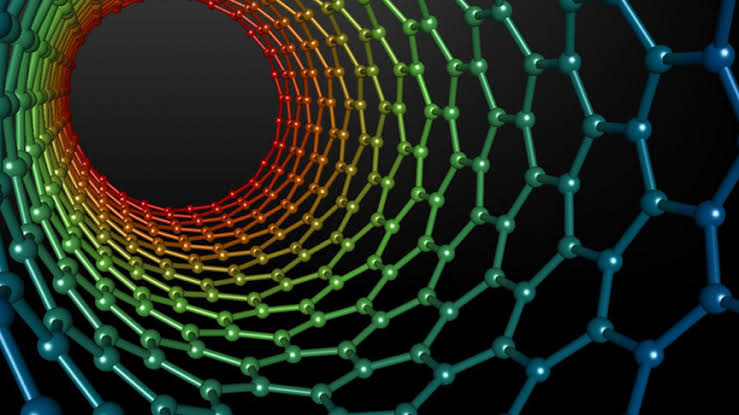
Carbon nanotubes are tubular forms of carbons it can be thought of as graphene sheets rolled into cylindrical form.They have diameters of few nanometres thus the name nanotube and their lengths are upto several micrometers.
Length in microns(10^-6 m) and diameter in nanometres (10^-9 m)
Each nanotube is made up of hexagonal network of covalently bonded carbon atoms.
Brief history
This structure was accidentally discovered in 1991 as minor product during the synthesis of fullerene (another allotrope of Carbon which will be discussed later).It was discovered by a scientist by the name S. Lijima .Carbon nanotubes that Iijima observed were so called multi-walled carbon nanotubes (MWNTs).
Different types of CNTs
There are two types of carbon nanotubes
1)Single-walled
2) Multi-walled
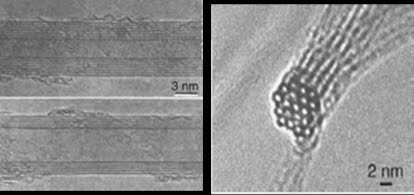
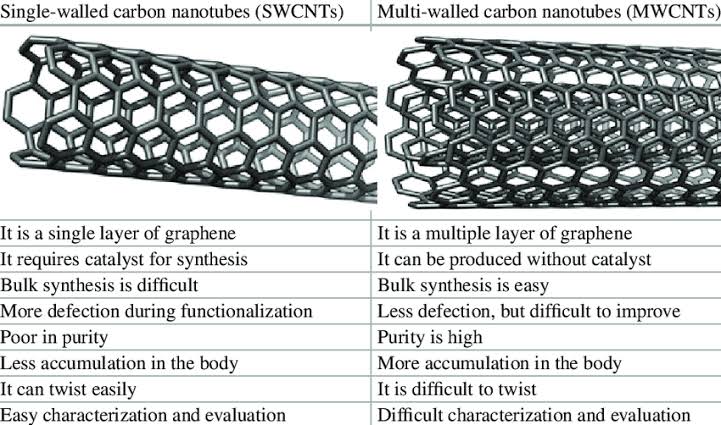
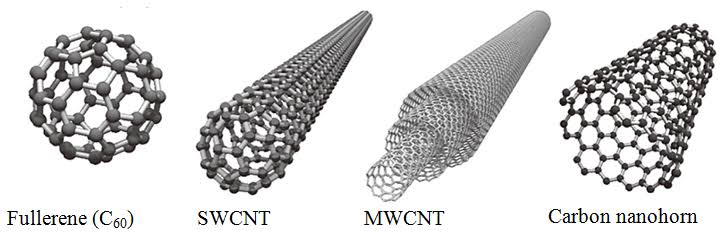
A single-walled carbon nanotube consists of a single graphene cylinder.
While multi-walled carbon nanotube consists of several concetric graphene cylinders.
Single-walled Nanotubes
This is further classified into
a) Zig-Zag
b)Arm-chair
c) Chiral
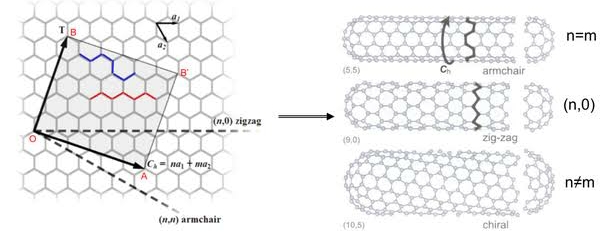
In zig-zag m=0 so the indices are of the form (n,0).
In arm-chair ,n=m so the indices are of the form (n,n) or (m,m)
In chiral n and m are different and not related so it remains (n,m)
Based on how the graphene sheet is wrapped the single walled nanotube in represented by a pair of indices (n,m) where n and m denote the unit vectors along two directions in the honeycomb crystal lattice of graphene as shown below
Oct 10th 2020
Multi walled nanotubes are also further divided into two types
1) Russian doll model– this is a carbon nanotube containing inside another carbon nanotube of smaller diameter .They look like sheets of graphite arranged in concentric cylinders.
2) Parchment model– It consists of a single sheet of graphite rolled around itself .
The inter-layer distance in this nanotube is close to graphite layer distance (that is approx 3.4 * 10^-10 m).
Preparation of Carbon nanotubes
There are two main methods to prepare the CNTs
Sublimation of graphite with subsequent desublimation
This method involves condensation of carbon atoms which are obtained by evaporating the solid carbon sources of graphite.
There are two ways of doing sublimation of the solid
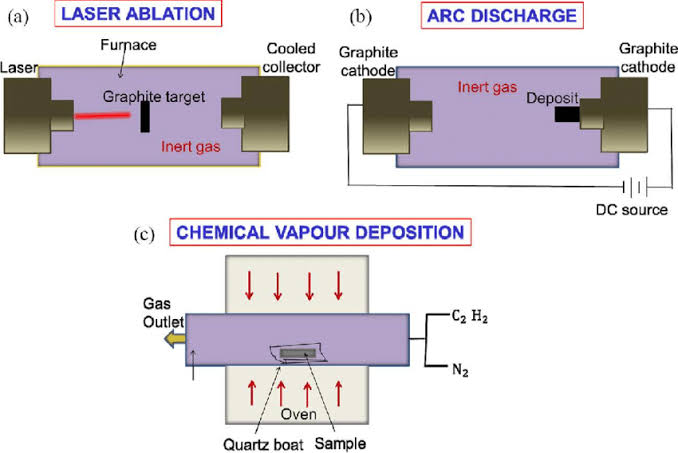
a) laser ablation
b) electric arc
Laster ablation method
In this method the graphite target is subjected to laser and the sublimed carbon is recollected all of these occurs in an inert gas atmosphere,at controlled temp.
Electric arc discharge method
The synthesis is performed in the presence of helium,argon or methane environment.
During the arching the graphite in the anode is evoparated and consumed and simultaneously carbon is deposited at or around the cathode .
It’s a highly effecient method as 60-70% weight of the deposited soot is carbon nanotubes and rest maybe fullernes,catalyst nanoparticles etc.
The quality of the nanotubes is dependent of arc stability , current density and cooling of cathode .
The second method is Chemical vapour decomposition
This method is used to produce large scale of carbon nanotubes
The process takes place at a temp of 500-1300 ° C.
Methane, alcohol ,benzene etc are the hydrocarbon precursors.
In this method there is initial dissociation of hydrocarbons followed by dissolution of carbon atoms in metal nanoparticles.
Thereafter precipitation of carbon.
Catalysts like -Fe,Co,Ni etc is used.
They serve as nucleation sites and also promotes pyrolysis of hydrocarbons.
 Site Title